Worship this Sunday is at 8:45 and 11AM.
By David Root
I’ve always lived on Indian land. I grew up in Ohio hearing about the Hopewell, Adena, Shawnee and Miami peoples. I went to college in the North Carolina Piedmont, formerly home to the Saura, Catawba and Cherokee tribes.
For many years I’ve lived in Decatur, Georgia on land once occupied by peoples who dwelt here for thousands of years before the arrival of Europeans and for hundreds of years afterward.
But few if any live near me now. They vanished 200 years ago. I confess that I’ve rarely thought about what became of them.
A while back David Lewicki preached a sermon lamenting that “for every single treaty, made with every single tribe, the result was the same. Every treaty was broken. We white people broke every promise we ever made. You and I live on land that was stolen.”
The idea that my Decatur bungalow sits on “stolen” land unsettled me, and motivated me to understand the history of the ground under my feet.
I began by asking my 8 year old grandson Benjamin if he would like to study the Indians who once lived in our part of Georgia. “I always want to learn history!” he exclaimed. He immediately named the Muscogee Creeks and Cherokees as the tribes in our area, demonstrating the excellence of his third grade education. Benjamin’s 5-year-old brother Noah overheard and begged to join our project, but admitted, “I don’t know anything about Indians, Grandpa.”
Benjamin raised one concern. “Grandpa, I don’t think we should call them Indians.” He had the idea this term might offend.
“What’s wrong with that?” I asked.
Benjamin gave me an impatient look. “They didn’t come from India, of course,” he said. “I think we should say ‘Native Americans.’”
I noted Benjamin’s point, and not wanting to derail our project before it started, looked at what the Smithsonian National Museum of the American Indian said about naming:
What is the correct terminology: American Indian, Native American, Indigenous, or Native? All of these terms are acceptable. The consensus, however, is that whenever possible, Native people prefer to be called by their specific tribal name.
I determined to use tribal names when possible, but I may also say Indians.
As Benjamin correctly noted, two tribes lived near Decatur. The Cheorkees lived north of us. The Muscogees, whom the English called the “Creeks,” were divided into the “Upper Creeks,” also to the north, and the “Lower Creeks,” in Decatur and south. According to the People’s History of Decatur,
Decatur, Georgia is located on Muscogee Creek land. People have lived in the region known today as the Southeastern United States for thousands of years. Major cultural centers, including those of the Muscogee Creek filled this land, sustained by plentiful natural resources as well as extensive agricultural production. These large, densely settled and politically complex communities featured towering temple mounds, large public buildings capable of seating hundreds, sometimes even thousands, of people, as well as individual family houses spread over many miles and enormous fields from which corn, beans, and other crops were harvested several times a year.
The native peoples in Georgia have origin stories similar to those found in Genesis. Author Bill Grantham gives the Muscogee Creek version:
It was in the beginning when people were first created. This is the history of the three tribes known as Kasihta, Chickasaw, and Coweta. Far off toward the west many people came out of the ground. . . At that time the people were without clothing or fire. And they sewed together leaves of trees with which to cover themselves. . . [T]he Breath-holder (Hisa’kita immi’si) spoke to them and said: ‘The earth which lies here is the foundation of all things.’ And he said: ‘The earth being created, the second thing is water, the third the trees and grass, and the fourth the things having life.’ Even down to the smallest things they were created.
The Cherokee tell a similar tale:
In the beginning, the Earth was a floating island in a sea, suspended by cords attached to Galun’lati, a sky world of solid rock. The Earth was soft and wet, and the animals sent out the Great Buzzard to prepare the world below for them, but he struggled to find dry land. He grew tired, and his wings began to hit the ground, creating a series of valleys and mountains. The mountainous country became Cherokee land. The Great Buzzard created animals and plants first, humans later. . .
The scientific origin account describes hunters who followed animals across the Bering Sea land bridge twelve thousand years ago, going from there to what would become the Southeastern United States where they settled and started to grow their food.
Two pre-European towns were near me. The first was Standing Peachtree, or “Pakanahuili.” The Muscogee Creeks strategically built this settlement at the confluence of Peachtree Creek and the Chattahoochee River. I hoped we could learn something by going there, and one summer morning grandson Noah and I set out to Atlanta’s Standing Peachtree Park to find it.
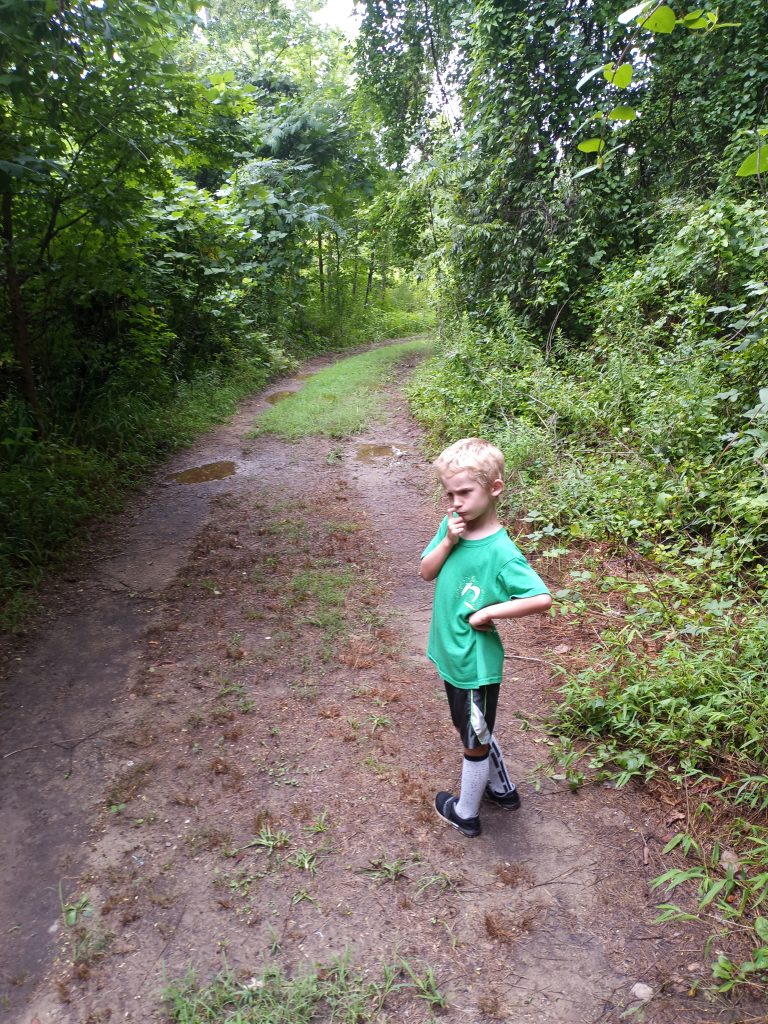
Other than a hundred year old stone picnic shelter near the entrance, it would be a stretch to call the place a park. We entered a patch of narrow, unkempt green space and drove a couple hundred yards to where the road ended at a locked fence surrounding the Atlanta waterworks. We parked and with some effort discovered an overgrown, unmarked trail running parallel to Peachtree Creek.
We hiked down the creek, across from a massive sewage treatment plant. I instructed Noah to keep a lookout for any signs of the old native town. “Don’t worry, I’m looking side to side, Grandpa!” he said. We soon came to the spot where the creek empties into the Chattahoochee River, the perfect site for a settlement.
There were no ruins or markers- nothing- to explain that this spot had once been an important native town. The only hint was a weather-beaten laminated flier tacked to a pole that advertised a “Forgotten History Event” from the previous year.
The story of Standing Peachtree is clearly forgotten. I’d be surprised if one in 10,000 Atlantans knew anything about the place, and if any of them took the time to visit, the trip wouldn’t teach them much.
The second nearby village was Sandtown, a Muscogee settlement on the Chattahoochee downstream of Standing Peachtree. Apart from a roadside historical marker, there is no clue that Sandtown ever existed. Sandtown had been surrounded by mounds, earthen structures built for burial purposes, temples or royal residences. In 1967, the Great Southwest Development Corporation leveled the Sandtown mounds to build the amusement park Six Flags Over Georgia. The boys and I decided there was little point to travelling there.
These early peoples left no writings, and few everyday objects or ruins to show us how they lived. To hold the attention of an 8 and 5 year old, I needed something other than empty fields and roadside markers.
I finally thought I’d found the answer: soapstone! Natives 3,000 years ago discovered how to carve this soft rock and shape it into bowls. Workers would chisel around a bulge on a boulder and remove a chunk of rock that could be sculpted into the desired object. Archeologists near Decatur have uncovered some of these curiously scarred rocks in abandoned quarries, the earliest evidence of prehistoric human activity near Decatur.
Rampant development has destroyed many of the quarries, but Dekalb County hauled one of these rocks up to the Decatur courthouse grounds and put a sign by it that said “STEATITE BOULDER.” Benjamin and I went to take a look. “So, what do you think Benj? Pretty cool, isn’t it?”
Benjamin tried to show interest. “It’s OK,” he managed. “It looks a little like a peach.”
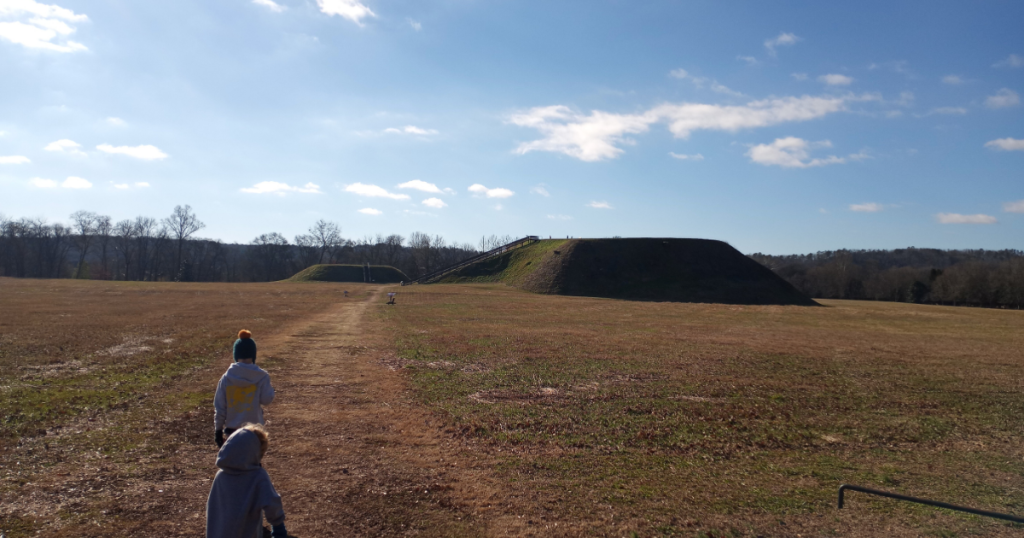
I had to do better to incite the boys’ interest. Thankfully, a few mounds remain in Georgia, and on a cold, clear January day, Benjamin, Noah and I drove 50 miles to the Etowah Indian Mounds State Historic site, where six mounds from the Mississippian Era sit atop a plain next to the Etowah River.
A lonely park ranger greeted us and eagerly offered an overview. “People made their way here from Siberia, following animals and warmer weather. They settled next to the river and began building mounds around 1000 C.E. Thousands of people lived here, and they had a flourishing culture.”
We explored the visitor’s center, including a diorama depicting the mounds and village in their heyday. I jogged after the boys as they sprinted through a room of empty glass display cases to the door leading outside to the mounds. These display cases had once contained sacred burial artifacts, but federal law allowed tribes to reclaim the material and they’d done so.
Benjamin and Noah raced to Mound A and up 63 feet of stairs to its broad flat top. The chief and his family had lived there, presiding over the village and its ceremonies. Mound A is the highest at the site, affording a view of the plaza, Mounds B and C, and the Etowah River.
Seizing the momentum from our trip to Etowah, Benjamin and I visited the Ocmulgee National Monument in Macon, Georgia. This site along the Ocmulgee River contains seven mounds once occupied by a community of 2,000. The Ocmulgee National Monument is in line to become a national park, which speaks to the growing awareness of native culture and the need to preserve it.
Considering how development has flattened similar sites, it is a miracle these mounds still exist. In 1874 railway construction sheared off part of a prominent funeral mound along the park’s eastern boundary. Interstate 16 forms the park’s western boundary, and its construction may have done similar damage.
Benjamin informed me with delight that no “artifacts” had been removed from the museum. “They still have the arrowheads!” he exclaimed, before learning that archeologists prefer the term “projectile points.” When I asked a ranger why this material had not been returned, like those at Etowah, she explained, “We only return the funerary pieces. Keeping that material is like pillaging a grave.”
The Great Temple Mound is Ocmulgee’s largest, but the Earth Lodge mound impressed us most. This structure has an east-facing entry door and tunnel leading straight to a large interior chamber deep within the mound. During the spring and fall equinoxes, the rising sun shines precisely into the entrance and down the tunnel, illuminating the chief’s seat on a raised eagle platform within. Benjamin wandered back and forth through the tunnel 4 or 5 times, captivated by its seeming magic.
The beginning of the end for Georgia’s Indians came 500 years ago when the first Europeans arrived. Historian John Grenier wrote that the Muscogee “had a special name for the [new] Georgians: ‘Ecunnaunuxulgee’—‘people greedily grasping after the lands of the red people.’”
But before taking much land, Europeans spread exotic diseases that overwhelmed the indigenous immune system, killing up to 90%. Spanish explorer Hernando de Soto trekked through Georgia in 1540, noting, “This country, according to what the Indians stated, had been very populous, but it had been decimated shortly before by a pestilence.”
English General James Oglethorpe founded the Georgia colony in 1732. Settlers began flooding in. In less than a year the Muscogees signed the Treaty of Savannah, handing the colonists a swath of land along the Atlantic coast. But the newcomers coveted more room to plant cotton, and in just a few decades, treaty after treaty carved away more slices of land, each parcel marked by Georgia’s rivers: the Treaty of Augusta in 1773 gave up land between the Little and Tugeloo Rivers; the Treaty of Augusta in 1783 gave up land between the Ogeechee and Oconee rivers; and the Treaty of New York in 1790 gave up land westward to the Apalachee and Oconee rivers.
The Muscogee had hoped to retain a sanctuary in the middle of the state, but treaty boundaries meant little to the relentless settlers who continued to advance.
By 1800 the Muscogees could feel their power waning. To encourage continued resistance, legendary Shawnee warrior Tecumseh traveled to Georgia in 1811 with the message to give no more land and drive the Americans back to the sea:
The Muscogee was once a mighty people. The Georgians trembled at your war whoop. . . Now your very blood is white; your tomahawks have no edge; your bows and arrows were buried with your fathers. Oh! Muscogees! . . . The Red Man owns the country, and the palefaces must never enjoy it! . . . Let the white race perish! They seize your land; they corrupt your women; they trample on the ashes of your dead! . . . Back! Back, ay, into the great water whose accursed waves brought them to our shores! Burn their dwellings! Destroy their stock! Slay their wives and children!
The Muscogee Creeks rose up, hanging red sticks in their village squares as a call to war. The Red Stick War of 1813-14 became their last act of resistance in western Georgia.
Meanwhile, Tennessian Andrew Jackson had organized a militia (including pro-American Cherokees) to stop them. Jackson’s forces dealt a decisive blow to the Muscogees on March 28, 1814 at Horseshoe Bend in Alabama, killing 800 Creeks and forcing the survivors to sign a treaty conveying two-thirds of their remaining territory– 22 million acres– to the U.S. The Creeks held on–just barely– to land west of the Ocmulgee River and in northern parts of Georgia, but Jackson wrote: “The power of the Creeks is I think forever broken.”
Jackson was prophetic, and within a few years the remaining Muscogee land in Georgia would be delivered to the Americans. William McIntosh, whose father was a Scotsman and mother Creek, was a chief of the Lower Creeks. He had fought with the Americans in the War of 1812 and with Jackson at Horseshoe Bend. He favored accommodation and assimilation with the Americans, but realizing that the settlers would inevitability take the land, he pursued the best deal he could for the Muscogees.
On January 8, 1821 the First Treaty of Indian Springs was signed at Chief McIntosh’s middle-Georgia plantation. The Lower Muscogee Creeks sold half their remaining land to the Americans, and McIntosh pocketed $40,000 as a fee for brokering the deal. This treaty ceded the land where my Decatur house would be built 84 years later.
Georgians wasted little time organizing their new territory. In 1822 the Georgia legislature created Dekalb County, with Hightower Trail–an Indian trading path– marking its northern boundary. State commissioners surveyed the new county, choosing land lot 246 at the intersection of two Muscogee trails for the new county seat of Decatur, incorporated on December 10, 1823. Lotteries quickly raffled off land to eager settlers.
The Second Treaty of Indian Springs in 1825, also orchestrated by McIntosh, was signed at the resort hotel he’d built near the springs two years earlier, and gave the remainder of Creek land in Georgia to the U.S. As part of the deal, McIntosh and his friends got $200,000 and land in Oklahoma.
McIntosh neglected to get consent from the Creek National Council before signing the treaty. As McIntosh consummated the deal in the hotel bar, Hopoethleyoholo, Chief of the Upper Creeks, swore revenge. To punish McIntosh’s treachery, the Creek National Council ordered his execution. The Law Menders, a Creek police force led by former Red Stick leader Menawa, stalked McIntosh 70 miles to his plantation on the Chattahoochee River and set fire to his house. When McIntosh rushed outside to escape to escape the flames, his pursuers riddled him with bullets, scalping his corpse good measure.
Benjamin and I visited Indian Springs, now a state park 50 miles south of Decatur. The Indians believed that the sulfuric spring water there contained healing spirits, and people still line up to fill plastic jugs with the foul-smelling stuff that continues to bubble out of the rocks. McIntosh’s resort hotel, built in the Federal style with hand-planed wide boards, wooden pegs, handmade bricks and a foundation of native stone, still stands as a museum. An alcove in the wall where the 1825 treaty was signed remains intact.
Jackson became president in 1829, and a year later signed the Indian Removal Act, providing “for an exchange of lands with the Indians residing in any of the states or territories and for their removal west of the river Mississippi.” The 1832 Treaty of Washington marked the end for the Muscogee Creeks in Georgia, stating simply, “The Creek tribe of Indians cede to the U.S. all their land east of the Mississippi River.”
The 1835 Treaty of New Echota likewise concluded Cherokee presence in Georgia, resulting in their removal on the Trail of Tears.
By 1840 nearly every Indian was gone from Georgia.
President Jackson, wildly popular in Georgia and throughout the United States, boasted:
Philanthropy could not wish to see this continent restored to the condition in which it was found by our forefathers. What good man would prefer a country covered with forests and ranged by a few thousand savages to our extensive Republic, studded with cities, towns, and prosperous farms, embellished with all the improvements which art can devise or industry execute, occupied by more than 12,000,000 happy people, and filled with all the blessings of liberty, civilization, and religion?
What I’ve learned about the native land under my feet can be stated succinctly: settlers came to Georgia for a better life, taking land long inhabited by others. They killed those inhabitants or forced their relocation. The settlers believed in “American exceptionalism”- that their religious, political way of life was superior. They felt no need to preserve native culture, and instead erased it and replaced it with their own, succeeding so magnificently that the Muscogee and Cherokee left hardly any imprint on present day Decatur, Georgia.
I grew up at a time when teachers glossed over painful stories of the past. That is changing, and now the darker side of our history is finally being taught, to the consternation of some who advocate removing any historical unpleasantness from our school curricula. They don’t want our kids to feel bad about the past.
But what’s wrong with feeling bad? If my grandsons’ generation learns the full story, might that inspire them to do better? History involves on-going fact-finding and evolving understanding, a process that can alter beliefs and open us to change and the possibility of forming a more perfect union. In the end, this may be the true mark of American exceptionalism.